
Blacksburg Resident Lookup Records
A useful Blacksburg resident lookup does not produce one official answer. It compares records that document distinct roles. The Montgomery real-estate portal identifies an assessed owner and mailing information associated with a parcel, not necessarily the person living there. The Virginia Citizen Portal is a person’s own registration-status route, not an open name directory. Court results identify a case and party role, while vital records have age and relationship limits. Begin with the record that fits the question, then preserve its date and source.
| Record | What It Confirms | Where | Access |
|---|---|---|---|
| Property assessment | Assessed owner, mailing data, parcel and legal description | Montgomery real-estate search | Public search form; it does not confirm occupancy |
| General District Court case | A named party, case number, court and case status | Virginia Judicial System | Public online search with excluded case categories |
| Vital record | A recorded birth, death, marriage, divorce, or related event | Virginia Office of Vital Records | Age, identity, and relationship rules apply |
| Election record | One person’s registration status, precinct, or polling route | Virginia Citizen Portal | Self-service; voter-list requests are restricted-use |
| Business or license filing | A state filing or town-regulated business activity | Virginia SCC and town records | Public filing trail; not a personal-residence finding |
With a street address, start with the assessor and record the parcel number. With a court case number, use the court system first. For an older family event, check whether the vital record has reached its public age before contacting the state custodian. That sequence limits broad name searching and keeps the purpose of each result clear.
Montgomery Court Name Search
The General District Court search begins by selecting Montgomery from the court list. It offers plaintiff or defendant name, case number, and hearing date methods. A name result can lead to a court file, but it does not establish a home address or resolve two people who share a name. Protective orders, civil commitments, and medical emergency custody or temporary detention orders are excluded from the online GDC display.
The captured Virginia GDC search shows the court-selection and search-method controls used for a Montgomery case inquiry.
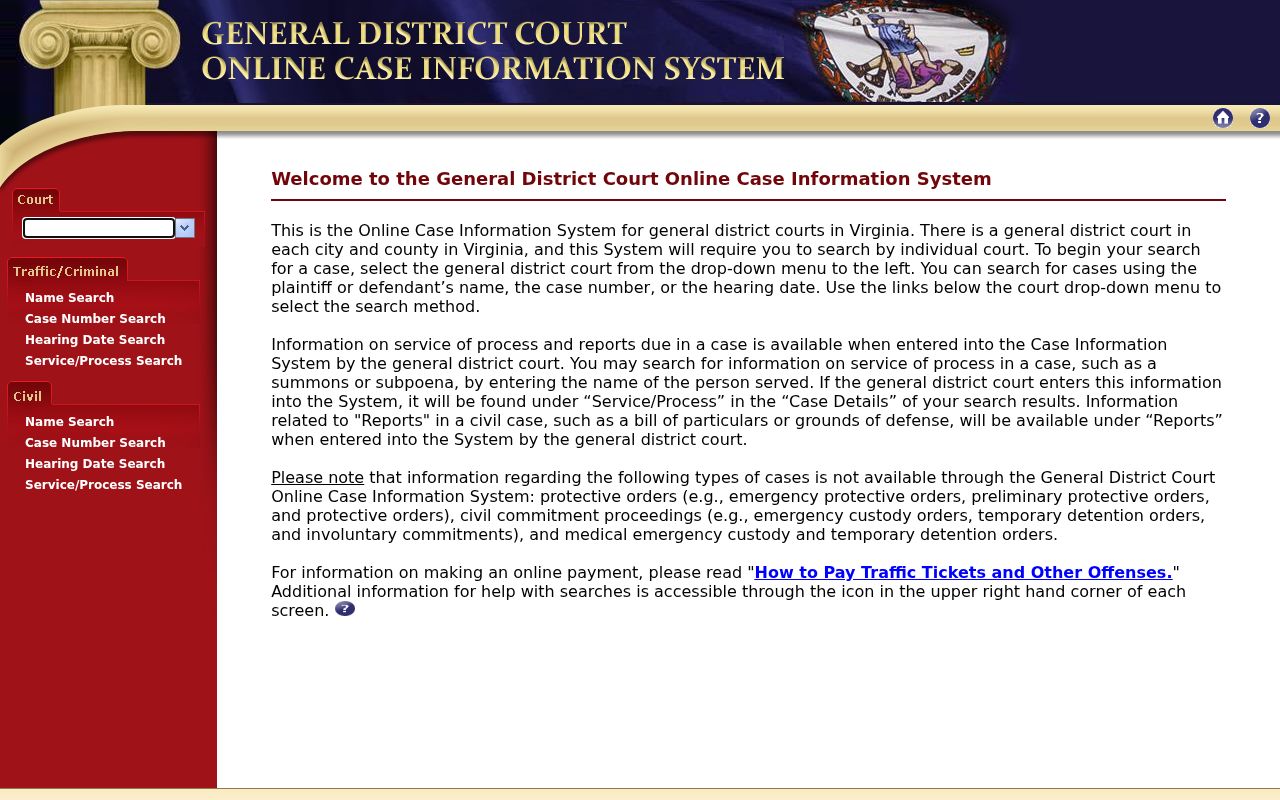
Use the locality selector before entering a name, and retain the case number and court shown in a result. Circuit cases use a separate search route, and the Virginia Judicial System says online information can be corrected or changed. The clerk’s file is the controlling source when an official copy is needed.
| Search option | Use and record |
|---|---|
| General district court | Select Montgomery before running a local search. |
| Plaintiff or defendant | A party-name method that needs a second identifying fact when names repeat. |
| Case number | The most precise route when it is already known. |
| Hearing date | A date-based route for a known court event, not a resident list. |
Reading a Blacksburg Court Result
For a court result that may relate to a Blacksburg resident, capture the fields that identify the record rather than copying personal details into a profile. The sample docket inventory is case number, court or locality, case type, party role and name, filing or hearing date, disposition or status, and any available service, process, or report link. Those fields make it possible to ask the clerk about one file without treating the search screen as final proof.
- Compare spelling, initials, and party role before treating two entries as related.
- Keep the court and locality with the case number because a number alone may be ambiguous.
- Use a date or an address-linked property record as an independent check.
- Ask the Montgomery Circuit Court Clerk for a certified copy when the record itself matters.
Montgomery Circuit Court preserves land, probate, marriage, judgment, and other statutory records, including historical material. Its courthouse is in Christiansburg, so a Blacksburg search often moves between town geography and a county custodian. A party named in a case should be described only as named in that case, not as a verified resident.
Vital Records for a Blacksburg Search
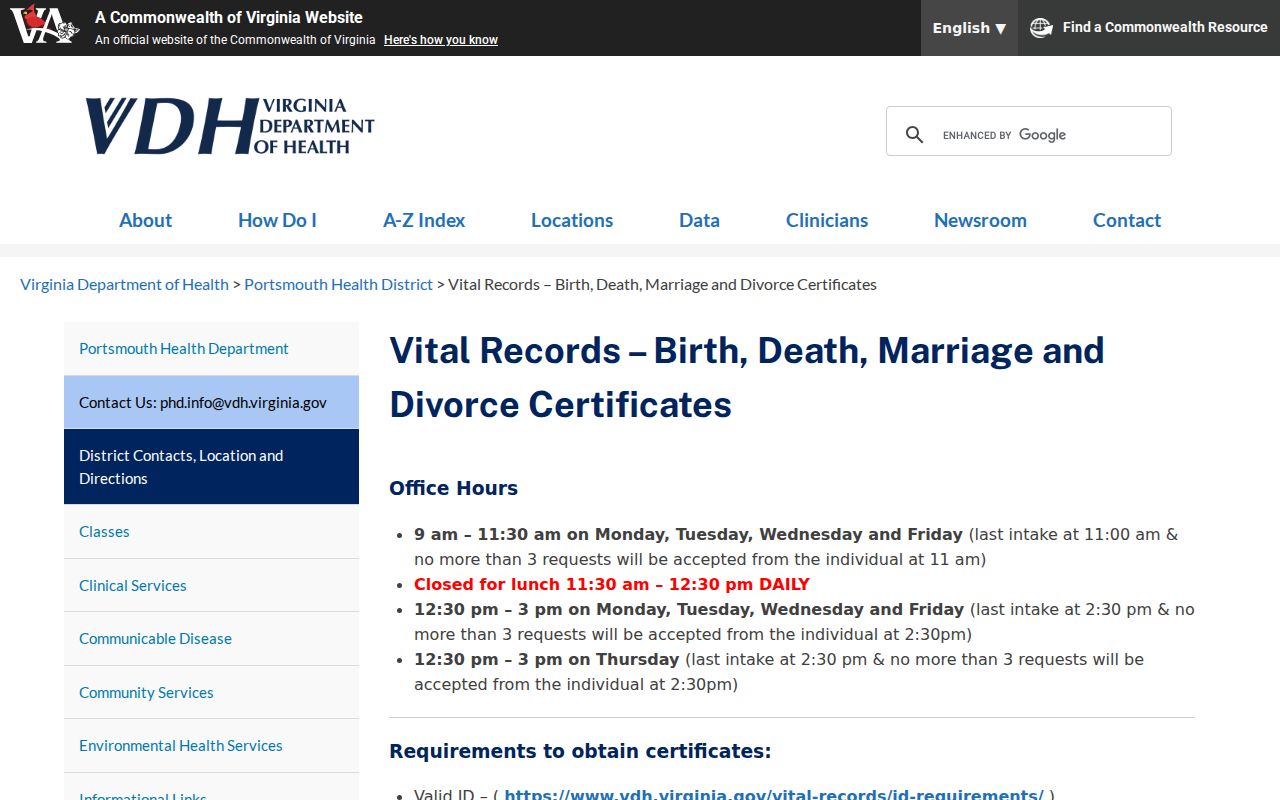
Virginia’s Office of Vital Records holds birth, death, marriage, divorce, and related certificates. Birth records become public after 100 years. Death, marriage, divorce, and annulment records become public after 25 years, subject to statutory exceptions. Newer certificates are not a way to look up a resident by name. VDH requires identity and an allowed relationship or other legal basis, and it lists parents, spouses, children, siblings, and grandparents among the immediate-family categories it recognizes.
The Virginia VS-6 application shows the record categories and requester fields used for a certificate request.
The form’s labels help identify the right certificate type, but identity, relationship, and payment fields are sensitive and should not be copied into a public listing. VDH reported a $15 search and copy fee during this research. Its online timing and paper timing statements differ, so check the live application page before relying on a processing estimate.
Confirming a Blacksburg Resident
Identity resolution in Montgomery records requires at least two independent attributes. A strong pairing might be a name with an exact street address, a name with a dated record role, or a name with a deed instrument and a contemporary directory or newspaper entry. Do not use a sensitive identifier to force a match. When those attributes do not align, leave the record unresolved rather than turning a possibility into a conclusion.
- Anchor the name to one dated property record or another record that states the relationship being checked. The assessor result is an assessed-owner record, not a statement about who occupies the address.
- Search the Virginia court system using the name and reasonable spelling variants, then retain the court, case number, party role, and date.
- Check an age-eligible vital index or historical source only for an event that can independently support the date and identity.
- Request a certified copy from the proper custodian if a legal or estate matter needs the official document.
- Docket
- A court’s running record of a case, including its identifying number, events, and status.
- Index vs. image
- An index points to a record through selected fields. An image is a view of the underlying document when the custodian makes one available.
- Certified copy
- A copy issued and certified by the record custodian for a use that requires official authentication.
Blacksburg License Name Trails
Business and professional records can help distinguish a named person or organization from another person with the same name. Blacksburg’s Finance Department publishes date-stamped monthly business-license reports and administers local licenses. A license documents a town-regulated business activity at the stated time. It does not prove that an owner, operator, or registered contact lives at the business address.
The Virginia State Corporation Commission’s Clerk’s Information System separates entity ID, entity name, name type, entity type, address, formation date, status, and status date. DPOR’s License Lookup accepts a name, license number, address, or license type, but its display is not itself the official public record. Keep a business address, a campus address, and an assessor mailing address as separate facts.
Blacksburg Historical Name Leads
For an older person or family, local collections can supply a dated lead that modern portals cannot. Montgomery-Floyd Regional Library points researchers toward Virginia Chronicle, a local newspaper archive, HeritageQuest, and Virginia Memory. Virginia Tech Special Collections holds letters, photographs, oral histories, genealogy material, and vertical files. The Blacksburg Vertical Files are open and mainly date from the 1960s forward, but the finding aid does not mean every item is online.
A newspaper item or 1932 directory entry records what a publisher or compiler printed at that time. Preserve the issue date, page image, and collection link, then compare it with a deed, cemetery, court, or vital source that answers a different question. Newspaper OCR can misread surnames, so the page image deserves more weight than a search snippet.
Blacksburg Records Request Route
When an existing record is not in a public search, the Virginia Freedom of Information Act provides a request route to the right public body. Blacksburg and Montgomery County accept requests by online form, mail, phone, email, or in person. A request need not use the word FOIA, but it should identify an existing record with reasonable specificity. Agencies do not have to answer a general question or build a new roster from several systems.
The normal response period is five working days after receipt, excluding weekends and holidays. A response may provide records, cite a lawful withholding, state that no record was found, or explain why more time is permitted. State the record series, date range, address or parcel if known, desired format, and a request for an advance cost estimate. For a partial withholding, ask for reasonably segregable nonexempt material.
Limits on a Blacksburg Resident Lookup
Virginia law and custodian policies limit what can be found or shared. Voter lists exclude sensitive fields and are controlled by a statutory request process. Court systems omit certain protected categories, and online case information is not always the official file. The Address Confidentiality Program can provide eligible survivors with a substitute mailing address. A substitute address must never be reverse searched or used to infer a physical location.
When a record appears wrong, seek correction from the agency that created or holds it. Keep a record’s scope precise: an assessed owner is not automatically an occupant, a business contact is not automatically a resident, and a historical directory entry is not current proof.
Lawful use. Use a Blacksburg resident lookup for personal, lawful research and source verification. Virginia’s anti-stalking law addresses repeated conduct that causes reasonable fear; never use record information to stalk, harass, intimidate, or harm anyone.