
Blacksburg Previous Residents by Era
Different records answer different parts of an address history. The county assessment portal is a recent parcel lead. A recorded deed names transaction parties. The Library of Virginia inventory points to older books and indexes. A directory or newspaper can place a person or business at a historical address, but it still needs its publication date preserved. The earliest useful source depends on the address and the era in question.
| Source | Years It Covers | Where Held | What It Shows |
|---|---|---|---|
| Montgomery real-estate portal | Current display, observed as current 1 September 2026 | Commissioner of Revenue online portal | Assessed owner, tax-map number, legal description, assessment, land size, and possible sketch |
| Circuit Clerk land records | Current instruments recorded daily; no complete public no-login historic online span located | Montgomery Circuit Court Clerk | Deeds, plats, easements, releases, and related instruments |
| Montgomery deed indexes and books | General grantor/grantee indexes, 1773-1933 | Library of Virginia microfilm inventory | Book, reel, date, and transaction leads for deeds and plats |
| Blacksburg, Cambria, and Christiansburg directory | 1932 | Gathering Blacksburg History and Blacksburg Museum collection | Historical person, business, locality, and street-address leads |
| Blacksburg Vertical Files | Mainly 1960s to present; predecessor clippings reach the 1870s | Virginia Tech Special Collections | Clippings, ephemera, and unpublished local material |
| Light Library newspaper material | Especially 1952-1998 | Montgomery Museum by appointment | Newspapers, family files, yearbooks, and local books |
A dated property or directory result is a lead for previous residents, not proof that the same person occupied the address for the entire period between records.
Blacksburg Previous Residents in Deeds
The recorded deed chain begins with a parcel, not a name alone. Montgomery County's real-estate portal can supply the tax-map number, legal description, and assessed owner associated with a result. The clerk's land-record material then provides the recorded-instrument route. A deed records a transaction party and an interest in land. It does not by itself establish that party's home address or that the person lived on the parcel.
- Search the address in the county portal and copy the tax-map number and legal description exactly as displayed.
- Use the owner and legal description to identify the most recent relevant recorded deed through the Circuit Clerk.
- Record the grantor, grantee, recording date, book and page or instrument reference, and the instrument type.
- Search the earlier party as a grantee to locate that party's prior acquisition, then repeat the process backward.
- When the trail reaches older material, use the Library of Virginia inventory to identify the proper index, book, reel, or clerk request.
Montgomery Circuit Court Clerk land-record guidance describes deeds, deeds of trust, plats, easements, powers of attorney, satisfactions, foreclosure deeds, covenants, and restrictions. The clerk records land records daily from 8:30 a.m. to 4 p.m. For copies, the public-records route asks for as much identifying information as possible, including book and page or instrument information when known.
- Grantor
- The party conveying an interest in an instrument.
- Grantee
- The party receiving the recorded interest in an instrument.
- Chain of title
- A sequence of recorded conveyances used to trace ownership interests backward through time.
- Legal description
- The parcel description used in records. It can remain more stable than a street-address form in older documents.
- Instrument reference
- A book-and-page or instrument number that lets the clerk locate the underlying record.
Blacksburg Previous Residents and Parcels
Montgomery County's address search is a practical first stop for a modern address. It is an assessed-real-estate tool, not a complete occupant database. The address form requires a street name, allows an optional street number and direction, and instructs users to omit the street type. The result can supply the tax-map number and legal description needed for the deed trail.
| Field | Documented use |
|---|---|
| Street Number | Optional text field |
| Street Name | Required text field; omit the street type |
| Direction | Optional dropdown |
| Wildcards | Supported for broader street searching |
| Result context | Sorting and results-per-page controls are available |
The portal displayed a maintenance notice during the research inspection. If it is unavailable, the documented fallback is the Commissioner of Revenue at 540-382-5717 or assessorsoffice@montgomerycountyva.gov. Move from the parcel result to MyGIS OneView for parcel lines, address points, map layers, zoning, voting and school districts, and adjacent-parcel context. The map is a reference tool, not a legal survey or final record determination.
Note: An assessed owner, mailing address, or neighboring parcel is not a substitute for evidence of who lived at a specific Blacksburg address.
Maps for Earlier Blacksburg Addresses
Historic maps can bridge a directory address and the physical setting at a particular date. Gathering Blacksburg History lists Sanborn editions for 1915, 1919, and 1921, plus town maps from 1900 and 1927. The Library of Congress 1921 Blacksburg Sanborn item is dated April 1921 and contains six sheets. It can show street layout, building footprints, construction material, and use labels.
Read every map as an edition. A label on a 1921 insurance map is not a modern parcel boundary, a resident roll, or proof of occupancy. Compare it with a deed's legal description and a directory page close in time. If the street form does not match, preserve both forms in the notes and seek another dated map or deed rather than forcing a match.
Map check. Keep the map edition, sheet number, source link, and the source date beside each address observation before comparing it with a directory or deed.
Blacksburg Previous Residents in Directories
The known 1932 Blacksburg, Cambria, and Christiansburg directory is a useful household and business lead, but it includes more than one locality. A name hit must be read with its locality heading and page image. The accessible sample identifies Alonzo Freeman Sr. as proprietor of the Blacksburg Press Shop at 302 East Jackson Street. It does not establish a spouse, owner status, or every person associated with that block.
Use a directory after the parcel and deed trail has supplied a stable place reference. The historical collection details and scan-handling method are kept on the Blacksburg city directory page. For an address history, the useful output is a dated line with its exact spelling, activity, locality, and source page.
Address flow: current parcel record → legal description → recorded deed reference → historic map → 1932 directory line → newspaper or archive lead.
Census Pairing for Blacksburg Addresses
Census material adds a household layer only when its date and address context fit the other records. The Blacksburg district research connects the 1932 directory with 1930 census material, and local sources list Montgomery census-enumeration maps for 1910, 1920, 1930, 1940, and 1950. Those maps help locate the correct geographic context before a household entry is compared with a street source.
- Start with the address form shown in the closest dated directory, deed, or map.
- Use the dated enumeration-map context to avoid treating a modern location label as an older boundary.
- Compare the census names with the source year, street, and record role, noting spelling variants.
- Check a newspaper, deed, or cemetery source for a separate dated observation before linking the records.
A census line, directory line, and deed can describe different relationships to the same place. Keep their roles separate: census context is household evidence, a directory can be a listing or business lead, and a deed records a land transaction.
Blacksburg Previous Residents in Archives
Virginia Tech's Blacksburg Vertical Files finding aid describes open material that dates mainly from the 1960s to the present, with clippings, ephemera, and unpublished local records. It lists 178 components but no online items. The appropriate next step is a scan request or reading-room visit, not an assumption that a finding-aid entry is the complete record.
The Virginia Tech finding aid is the source represented by the project image below.
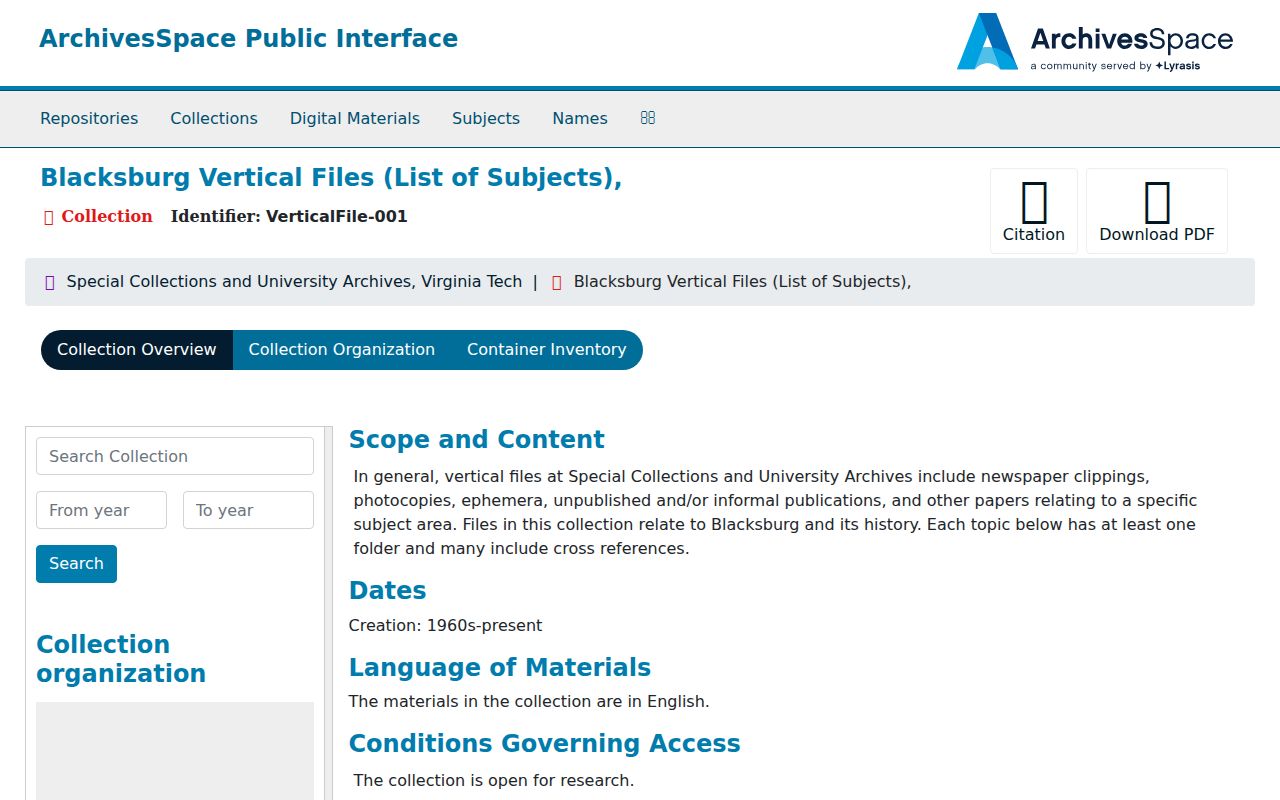
Vertical-file material can supply a name, street, organization, clipping date, or local event lead that is then checked against a map, directory, deed, or newspaper page.
For later newspaper and family-history leads, Montgomery Museum's appointment-based Light Library reports material from colonial times to the present and newspaper strengths for 1952-1998. Montgomery-Floyd Regional Library also links Virginia Chronicle and a local digital news archive. OCR can misread names, so keep the newspaper page image and publication date.
Blacksburg Previous Residents After Death
Obituaries, cemetery administration, and estate material can close or clarify a historical address trail, but none should be treated as automatic proof of last residence. Town-owned Westview Cemetery and Southview Memorial Gardens have lot, deed, transfer, interment, and map records split between town offices. Public Works handles lot sales, interments, and maintenance, while Finance handles records, deeds, lot transfers, payments, and maps. No online name, lot, interment, or digitized cemetery-map lookup was located.
A cemetery request should name the cemetery and, when known, the lot or section, person, date range, and desired deed, interment, or map record. Pair that response with Virginia Chronicle, the local newspaper archive, Light Library files, and Library of Virginia material. Cemetery presence records a burial or lot history. It does not establish the person's final residence, cause of death, or a living relative's contact details.
Limits on Blacksburg Address Research
Previous residents research should remain a property-history or family-history task with clear dates and source labels. The research did not locate a public current household roster, public neighbor-name search, complete historic online deed index, verified reverse-directory run, or complete MFRL directory inventory. Virginia's Address Confidentiality Program also provides a substitute mailing address for eligible survivors, and protected information must not be reconstructed or shared.
Lawful use. Use historical address research for personal, lawful purposes such as family history or understanding a property record. Do not use any result to stalk, harass, or harm a person, and do not pursue protected addresses.