
Blacksburg City Directory Collections
The most direct historical directory lead is a scanned volume titled City Directory of Christiansburg, Va., Cambria, Va., Blacksburg, Va. 1932. Gathering Blacksburg History hosts a page for the item and a searchable PDF, and attributes it to the Blacksburg Museum collection. It is a dated regional source, not a current list. A hit therefore needs its printed locality heading retained, because the volume includes Cambria and Christiansburg as well as Blacksburg.
Other institutions hold supporting material rather than a confirmed continuous run of printed local directories. The table separates what is actually documented from useful adjacent collections, so a missing year is not mistaken for a gap that has been proved.
| Collection | Years | Where Held | Access |
|---|---|---|---|
| Blacksburg, Cambria, and Christiansburg directory | 1932 | Gathering Blacksburg History, attributed to Blacksburg Museum | Searchable PDF online |
| Light Library newspapers, family files, yearbooks, and local books | Colonial period to present; newspapers especially 1952-1998 | Montgomery Museum | Appointment-based research |
| Virginia Chronicle newspaper pages | 1787-2013 by page and collection | Linked through Montgomery-Floyd Regional Library | Free full-text pages |
| Blacksburg Vertical Files | Mainly 1960s to present; predecessor clippings reach the 1870s | Virginia Tech Special Collections | Open finding aid; request scans or visit |
| Montgomery land and index microfilm | 1773-1933 general deed indexes | Library of Virginia | Finding aid, library, archive, or clerk route |
No official current Blacksburg resident directory, official reverse-directory run, or complete publisher catalog for the 1932 scan was located in the research sources. Treat those as real limits, not reasons to fill in the missing years from inference.
The 1932 Blacksburg City Directory
The 1932 scan is useful because it joins a person or business with a street address at one point in time. The accessible Blacksburg district material gives a concrete example: Alonzo Freeman Sr. is identified as proprietor of the Blacksburg Press Shop at 302 East Jackson Street. That does not prove a spouse, ownership status, or every nearby person in the original volume. Those fields were not located in the accessible official sources and should remain unknown until a source page supports them.
Use the scan as a captured record rather than an OCR answer alone. Search can locate a possible name, but the image supplies the spelling, heading, and line context that OCR often misses.
| Person | Alonzo Freeman Sr. |
|---|---|
| Occupation or business | Proprietor, Blacksburg Press Shop |
| Historical address | 302 E. Jackson Street, Blacksburg |
| Locality context | Blacksburg district material |
| Spouse or household | Not located in the accessible sources; do not infer it from a nearby line |
| Owner or renter mark | Not located in the accessible sources |
Note: The example is a 1932 address-and-business connection, not a present-day residence confirmation or a complete household reconstruction.
Reading a Blacksburg City Directory Entry
Record the printed name exactly, then separate it from the occupation, business name, street address, locality heading, and page number. An entry may be an individual, a business, an institution, a boarding-house style listing, or a cross-reference. That distinction matters. A press-shop address, for example, may identify a place of work instead of the proprietor's residence.
Keep the cover and the page containing the hit. If the PDF search produces a result, inspect the scan before copying a name into notes. The research did not find a verified abbreviation key for the 1932 document, so unexplained marks should be transcribed as seen rather than expanded.
- Criss-cross directory
- A directory arranged by street and number instead of by name. No verified Blacksburg criss-cross run was located in the reviewed sources.
- Householder index
- An index that groups a dwelling under a named household contact. A neighboring listing alone is not enough to create that relationship.
- Abbreviation key
- A publisher's explanation of shortened labels and symbols. Photograph or save it when a volume supplies one.
- Directory image
- The scanned page itself, which is the check on an OCR result and the source for its line context.
Blacksburg City Directories at Libraries
Montgomery-Floyd Regional Library's Blacksburg branch is at 200 Miller Street and lists Sunday hours of 1-5, Monday through Thursday hours of 9-8, and Friday and Saturday hours of 10-5. Its genealogy links point researchers toward Virginia Chronicle, the local newspaper archive, Virginia Memory, and library-mediated genealogy databases. The library's official pages did not identify a printed Blacksburg directory run, so ask about a specific source rather than assuming shelf coverage.
The branch page captured in the project manifest provides the local access point for a visit.
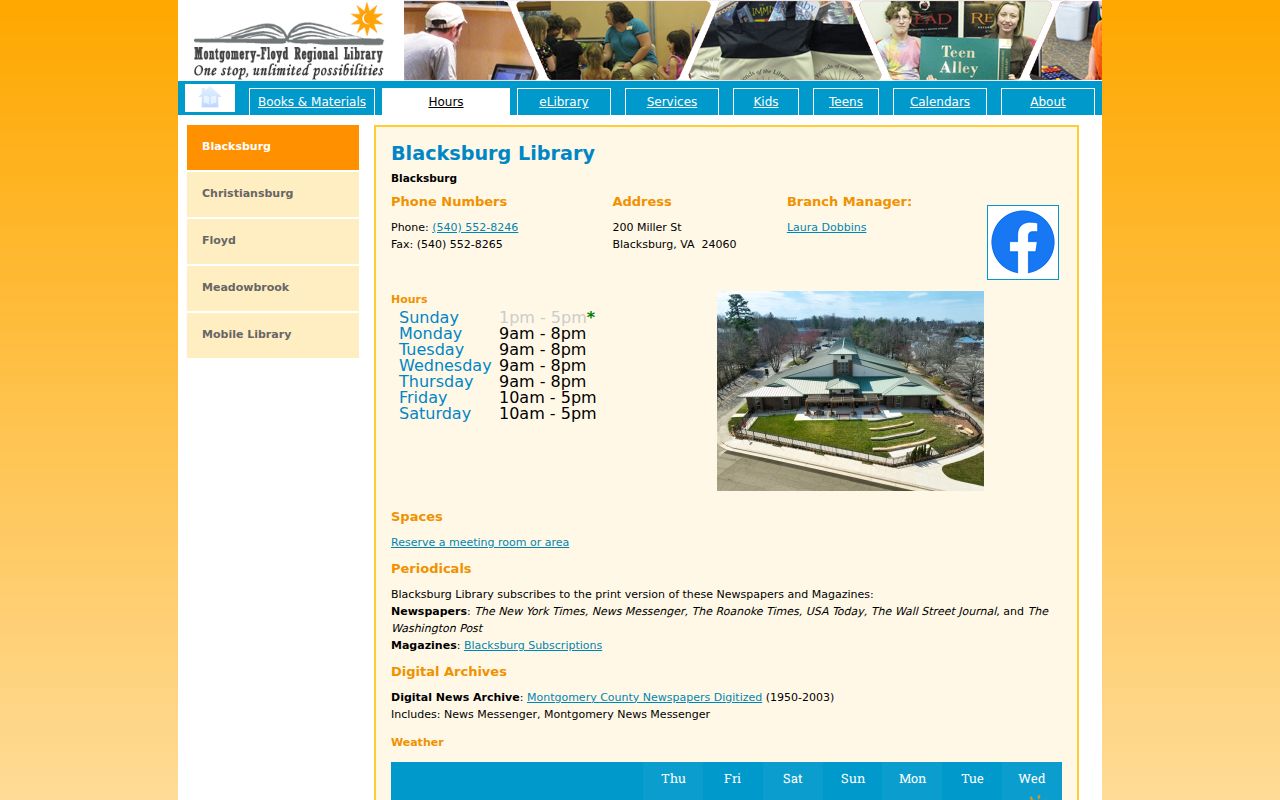
The branch and its genealogy links are practical routes for checking newspaper and library database evidence beside a city directory entry.
Montgomery Museum research appointments lead to the Light Library, which reports family-history books and files, yearbooks, local family histories, and books about Blacksburg, Christiansburg, Virginia Tech, and local townships. Its newspaper holdings are described as particularly strong for the News Messenger and Radford Messenger from 1952 through 1998. The museum requires an appointment and does not publish a complete person-name catalog or research fee online.
The Light Library research page is the source represented by this project image.
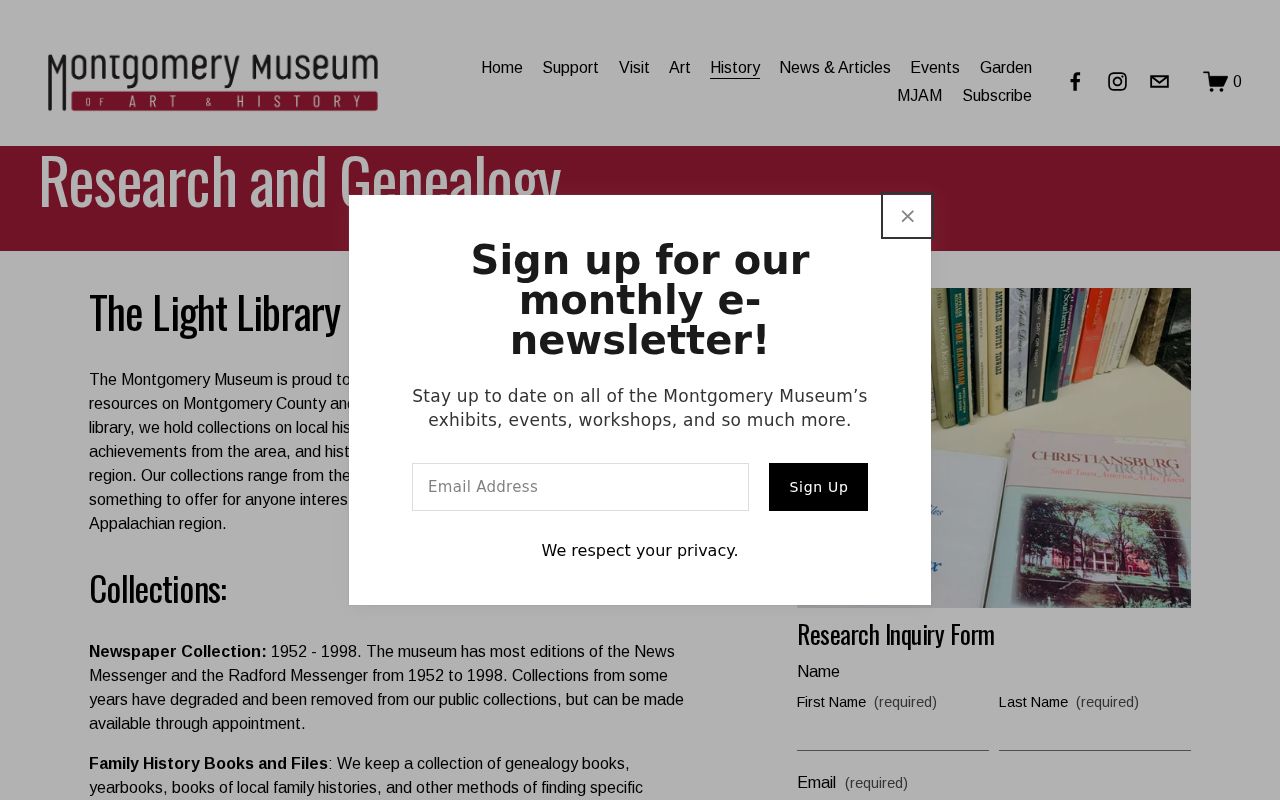
Use the appointment route for a defined surname, street, newspaper date, or yearbook question, then preserve the collection and publication details with each find.
Maps Beside Blacksburg City Directories
Historic maps make a directory address easier to read in place, but they do not name every occupant. Gathering Blacksburg History identifies Sanborn map years of 1915, 1919, and 1921, as well as town maps from 1900 and 1927. The Library of Congress describes its April 1921 Blacksburg Sanborn item as six sheets and a public-domain resource. Compare the map's date with the directory date before drawing a conclusion about a building or street.
- 1900: a Blacksburg town map is listed in the local map collection.
- 1915 and 1919: Sanborn map editions provide earlier built-environment context.
- April 1921: the Library of Congress Blacksburg Sanborn item contains six sheets.
- 1927: a later town map is listed before the 1932 directory snapshot.
- 1932: the combined Blacksburg, Cambria, and Christiansburg directory fixes its own publication date.
Street layout, footprints, construction material, and use labels can help distinguish a business location from a residence. Pair map evidence with deeds and a dated directory line instead of treating a building label as a resident roll.
Tracing Blacksburg City Directory Households
A household trail starts with one observed line, not an assumed family group. The 1932 scan can be paired with the 1930 census context noted in the Blacksburg district research, then with deeds, maps, newspapers, cemetery material, and later records where dates align. The point is to establish a sequence of dated observations. A person can move, a business can use a separate address, and a spelling can vary.
- Find the name or street in the 1932 scan and save the cover plus the result page.
- Write down the exact spelling, activity, address, locality heading, and page number.
- Check the address against a map close in date and keep the edition and sheet information.
- Compare the historical entry with the relevant census context, without assuming that nearby lines are one household.
- Use the Montgomery deed index or clerk record to test an ownership transition, then use newspaper or cemetery sources for later leads.
A disappearance from a city directory can mean a move, death, a changed listing practice, or simple omission. It is a reason to check another dated source, not a conclusion by itself. The modern parcel workflow belongs on the Blacksburg street directory page.
Blacksburg City Directory Address Context
When a historical Blacksburg city directory gives a street address, preserve that form before searching modern tools. The clean address workflow in the local research starts with USPS address validation, then the Montgomery County address portal, MyGIS OneView, and the Circuit Clerk for a recorded deed or plat. That sequence identifies parcel context and recorded instruments, but it does not turn a 1932 listing into a current occupant record.
For a historical address, compare the directory date with the closest map date first. Then carry the directory spelling, map sheet, tax-map number, legal description, and deed reference as separate notes. Each one is a different kind of record. The result is more useful than a blended profile because a reader can see precisely which source supports the person, place, or transaction.
Black Community Records in Blacksburg
Gathering African American Past's Blacksburg district material links names, occupations, Jackson and Bennett streets, census references, registration material, birth records, and obituary research. It provides context for Alonzo Freeman Sr. and the Blacksburg Press Shop while keeping each source type separate. That approach is important for community history, where spelling differences and incomplete survival can leave gaps.
The Library of Virginia inventory adds another historical route: Free Negro Registers covering 1824-1847 and 1848-1863 for Montgomery County. Pair a register finding with marriage, deed, court-order, newspaper, cemetery, and community-history material. If the sources do not resolve an identity, retain the gap rather than joining names by guesswork.
Note: Historical labels and archived addresses need their own dates, locality, and source citation before they are compared with any other record.
Later Blacksburg Directory Leads
Virginia Tech Special Collections holds local and regional letters, diaries, photographs, oral histories, organization records, genealogy material, rare books, and vertical files. The Blacksburg Vertical Files are open and mainly date from the 1960s to the present, but the finding aid lists no online items. Request scans or use the reading room instead of treating the catalog description as the document itself.
The open Town of Blacksburg collection includes financial statements from 1927-1951, a 1954 annual report, a 1944 population study, Chamber brochures, an 1885 ordinance/by-laws item, and election material from 1936-1968. The Library of Virginia inventory also lists Town Council minute volumes from 1871 through 1979. These are strong ways to place a name or organization in a dated civic record, but they are not complete population lists.
Blacksburg City Directory Limits
City directories are historical leads. The known 1932 volume does not document complete coverage, a verified reverse section, a publisher catalog, or every household. It also includes more than one locality. Keep a source label such as “historical directory entry,” preserve the publication year, and verify any later claim through the custodian or collection that holds the underlying record.
Date first. A historical address, cemetery record, map label, newspaper item, or directory entry should never be presented as a current residence without a separate current source.